
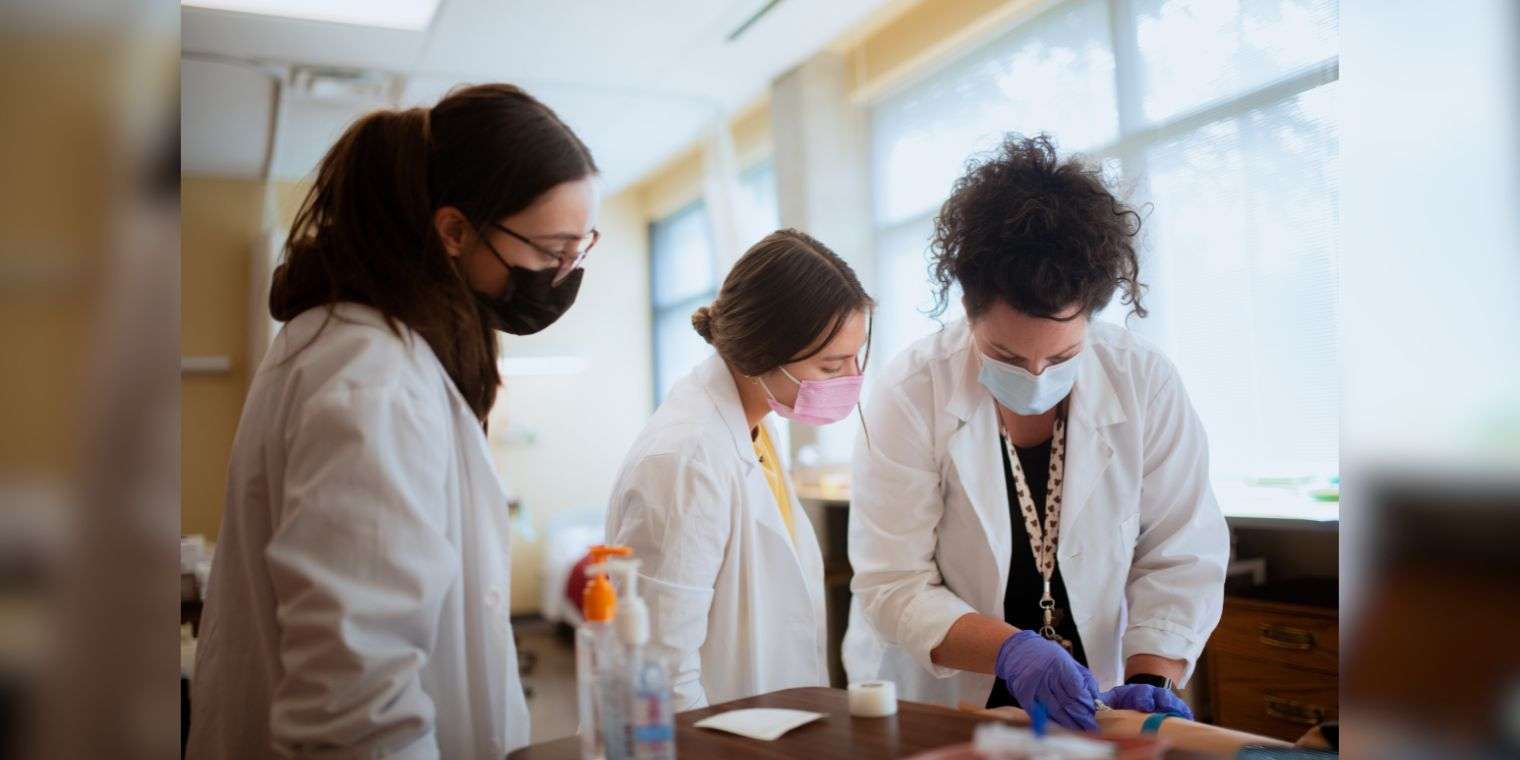
Health care simulation has emerged as a vital tool for health care professionals to enhance their skills and improve patient safety. At Northwest University, we see this as a unique opportunity for our nursing and theatre students to collaboratively develop their skills.
What is Health Care Simulation?
The Society for Simulation in Healthcare (SSH) defines health care simulation as a technique that "creates a situation or environment to allow persons to experience a representation of a real health care event for the purpose of practice, learning, evaluation, testing, or to gain understanding of systems or human actions."
Simulation is becoming increasingly more important in the context of health care education. It involves the use of interactive scenarios that simulate real-life situations to provide hands-on training and education, which are essential in providing the proper framework for treating patients before actually practicing in a health care setting. Traditional clinical settings like hospitals and clinics have become more restrictive in allowing nursing students to practice nursing skills, and in many cases, nursing students are not allowed to fully participate in patient care. Simulation allows students to independently practice nursing management of complex medical situations, such as cardiac arrest, trauma, or obstetrical emergencies which they would sometimes never experience at the student level.
Health care simulation can take on many forms—from virtual reality simulations to high-fidelity mannequins that mimic human physiology and respond to interventions. One type of health care simulation incorporates real people who act out various health concerns. This discipline employs individuals, known as standardized patients, who are specifically trained to portray patients with detailed medical conditions. The concept of standardized patients in health care education is not new, with its origins dating back to the 1960s. Standardized patients have been incorporated into various levels of health care education, as they allow students to practice their skills while in a realistic yet controlled environment.
Northwest University’s Theatre Program Contribution
Chrystal Helmcke, associate professor of Communication Studies and Theatre at Northwest University, recently partnered with Buntain College of Nursing (BCON) professors Ashley Ott and Tiffany Zyniewicz to develop a pilot program to train theatre students as standardized patients. The BCON has utilized simulation for the past several years, with students engaging in simulated clinical experiences with high-fidelity mannequins that mimic real human reactions. Though these opportunities have been useful for supplementing nursing students’ practical education, faculty decided to incorporate some more realism in nursing student experiences by partnering with theatre faculty and students.
Undergraduate students in the theatre program’s improv club were hand-selected by both Helmcke and Sound Design professor Kate Orr based on a set of criteria they felt would be beneficial in providing good standardized patients. “Kate and I established some qualifications that we believed would be essential [and] wanted our candidates to have maturity, theatrical experience, reliability, courage, and be personable,” shared professor Helmcke. Students who were selected participated voluntarily in the pilot program and were given background training on medical conditions and terminology. “First, the actors were provided with comprehensive scenario descriptions written by professor Ott so that they could gain a clear understanding of the characters' backstories and ‘current’ circumstances. In addition to the demographic and sociological information, professor Ott provided the actors with some basic medical vocabulary that related directly to the condition of the patient, along with links to some videos that illustrated even further the medical elements.” Afterwards, student actors were involved in a two-hour training event where they learned the best practices for standardized patients, went over the clinical schedule, and learned how to apply various theatrical skills. Before the actual simulated clinicals, Helmcke met with the student actors to finalize plans and discuss costume ideas.The student actors then progressed to the simulation lab.
During nursing simulation labs, theatre students implemented their newly gained standardized patient training to support the outcomes of nursing students, who reported that they enjoyed working with real people more than animated mannequins. Students described feeling better connected with their “patients” and were more immersed in the scenarios. Rather than evaluating the vital signs of mannequins, which several students felt as being unnatural and awkward at times, BCON nursing students treated real human beings. Being in a more authentic environment allowed the nursing students to practice their skills more effectively while still in a regulated space, ultimately improving their competence and evaluation of techniques in real-life health care situations.
Though this was a pilot project, the faculty members who ran the program are optimistic about future standardized patient opportunities. Ott and Helmcke are planning to run another standardized patient experience during the Fall 2023 semester. Helmcke mentions that she would love to launch a program where students who are interested in pursuing acting roles as standardized patients would be able to learn more about the field and earn academic credit. Students in both the nursing and theatre programs expressed significant interest in continuing this program, so the future seems bright for standardized patient simulation at Northwest University.
Interested in a nursing career? Explore our degrees in the Buntain College of Nursing.
Interested in our theatre program? Learn more about our Bachelor of Arts in Communication Studies.